A Trading Course That Starts Before The First Chart, At What A Stock Actually Is
Every trading course we've ever looked at skips the same ten minutes: the part where someone explains what a stock actually is.
You'll get every term defined the moment it's used, the first time it shows up, with nothing assumed and nothing skipped because "everyone already knows that."
You'll get all 11 parts and 66 lessons, live today, start to finish: what a share actually is, how to open and use a brokerage account, how to read a chart, position sizing, trading psychology, and a week-by-week plan for your first 90 days.
You'll get genuine worked numbers everywhere a normal course would wave a hand and say "for example," not an invented case study about a fictional student named Sarah.
Most courses assume you already know the first ten minutes, so they start at minute eleven and lose you there.
This one starts at minute zero, on purpose, and every future addition to it, worked examples, calculators, cross-references, unlocks in your course automatically, for good, at no extra cost.

Every trading course we've ever looked at skips the same ten minutes: the part where someone explains what a stock actually is.Jason Parker, Founder of Trading Habits
Introducing The Ultimate Beginner Trader's Course.
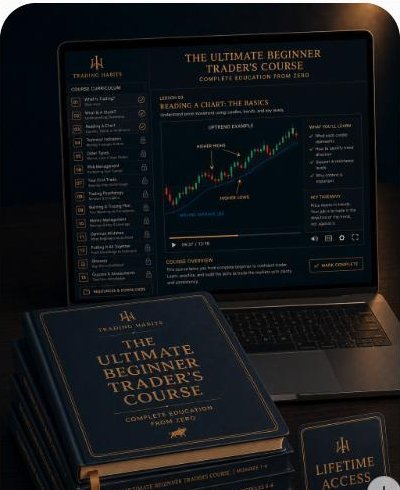
The Ultimate Beginner Trader's Course
A complete trading education, starting from the actual beginning, for someone who has genuinely never done this before.
- Format A private, self-paced course page with interactive lessons, quizzes, and a glossary. No app, no login, only your own link
- Access Instant after checkout, yours for good, including every future update
- Starting point Zero. No prior trading, investing, or finance knowledge assumed
- Curriculum Complete. All 11 parts, 66 lessons, start to finish, with more depth added on top over time at no extra cost
- Author TradingHabits.com
Built for one job: taking someone from "I don't know what a ticker is" to a genuine, working foundation, one explained term at a time.
What's Inside
Built Different From a Normal Course
- 01Every lesson defines its own jargon inline, the first time a term shows up, so you're never left behind three sentences later, nodding along at something you never actually understood.
- 02A running glossary of every term the course uses, built as click-to-reveal flashcards, so you can check a word in seconds instead of losing your place hunting through old lessons.
- 03Short knowledge checks at the end of each part with instant feedback and no grade, so you find out what didn't land while it's still cheap to fix, not three weeks later in a live trade.
- 04Custom diagrams for the genuinely confusing stuff, the bid/ask spread, a candlestick frame by frame, how an order actually moves from your screen to a filled trade, so you can see the mechanism instead of just memorizing the definition.
- 05Genuine worked numbers everywhere a normal course waves a hand and says "for example." No invented case studies, no fake student named Sarah, just math you can rerun on your own account.
- 06The 11-part curriculum is complete today, and depth keeps getting added on top of it, worked examples, calculators, interactive tools, at no extra cost, so the course you bought keeps getting more useful without you ever paying again.
- 07A Setup Practice Lab in the candlestick lesson: 12 interactive drills where you call Buy or Sell before the next candle prints, so you find out what you'd have actually done, not what you'd like to believe you'd have done.
- 08Full-text search built into the course page: type "margin call" or "stop-loss" and jump straight to the lesson or glossary card that covers it, out of 66 lessons and 74 terms, instead of scrolling to find it again.
- 09A "Print / Save as PDF" button on the course page: one click formats every lesson, diagram, and glossary card for a clean printout, so the material works away from a screen too, on the desk next to your monitor.
The Full Curriculum
Everything the Course Covers, Start to Finish
- What trading means, in plain English
- Investing vs. trading: they are not the same activity
- An honest self-check: is this for you right now
- The Ultimate Beginner Trader's Glossary (interactive flashcards)
- Bonus: the First Principles Lab, five scenarios pulling what a trade is, investing vs. trading, the self-check, and the glossary back together
- What a company is, and what it means to own part of one
- What a stock share literally is
- Stock exchanges, and what happens when a trade executes
- Tickers, prices, and the bid/ask spread, explained visually
- Beyond stocks: a beginner's map of ETFs, options, futures, forex, and crypto
- Part 1 knowledge check (interactive quiz)
- Bonus: the Ownership and Market Math Lab, five fresh-numbers questions across market cap, the bid/ask fill, and the order-routing path
- Choosing and opening a brokerage account, step by step
- Cash accounts vs. margin accounts, and what that changes in practice
- Market orders, limit orders, and stop orders, explained with genuine fills
- How to place your first order without guessing at a single field
- Part 2 knowledge check (interactive quiz)
- Bonus: the Order Type Scenario Lab, five order tickets, market, limit, stop, and stop-limit, pick the right tool for each
- Price and time: the only two axes a chart has
- Candlesticks, from the shape up, no assumed knowledge
- Volume, and what it's measuring
- Timeframes: why the same stock looks like two different charts
- Part 3 knowledge check (interactive quiz)
- Bonus: the Chart Literacy Scenario Lab, five chart reads combining color, wicks, volume, and timeframe with nothing labeled
- Support and resistance, and why they're not magic lines
- Trend: how to tell what one is, not merely sense it
- Moving averages, built up from a simple average you already know
- A short, honest tour of indicators, and what they can't do
- Part 4 knowledge check (interactive quiz)
- Bonus: the Chart Reading Practice Lab, four charts, four questions, spot support, resistance, trend, and moving averages on your own
- Why this part comes before strategy, not after
- Stop-losses, in plain terms, with a genuine worked example
- Position sizing from scratch, using two live in-lesson calculators plus the site's own Position Size tool
- What "risking 1%" actually means in dollars, on your own account
- Part 5 knowledge check (interactive quiz)
- Bonus: the Position Sizing Scenario Lab, one running account, two trades, five decisions on when the risk percentage recalculates and when it doesn't
- What a trading plan actually is, and why a strategy alone was never enough
- Setup criteria: defining exactly when you'll enter a trade
- Entry, exit, and circuit-breaker rules, built from Part 5's own numbers
- Build your own one-page trading plan, an interactive fillable page that saves in your browser and downloads as a text file
- Part 6 knowledge check (interactive quiz)
- Bonus: the Setup Criteria Scenario Lab, five candidate stocks, three numbers each, one question every time: does this one actually clear the bar
- Loss aversion: why losses feel worse than equivalent gains feel good
- Your first genuine loss, and what usually goes wrong right after it
- Revenge trading, named and self-checked before it happens to you
- Confirmation bias, FOMO, and following your own rules when no one's watching
- Part 7 knowledge check (interactive quiz)
- Bonus: the Psychology Under Pressure Scenario Lab, five emotionally-charged moments, pick a response, watch the tally move
- What actually happens when an order fills, including partial fills and slippage
- Managing a trade after entry: trailing stops in the right direction, not the wrong one
- Taking partial profits, worked in genuine dollars from the Part 5 and Part 6 numbers
- The Trade Management Scenario Lab: one live position, four decisions, played out
- Part 8 knowledge check (interactive quiz)
- Paper trading, done properly instead of as an afterthought
- Starting your first trading journal, and what to actually write in it
- Win rate, average win and loss, and expectancy, with a live calculator
- Readiness signals: an honest self-check before genuine, small size
- Part 9 knowledge check (interactive quiz)
- Bonus: the Trading Stats Reality Check Lab, five trader profiles, same win-rate-and-expectancy math, read the numbers honestly and decide who's actually ready
- What to actually do the week you finish this course, in order
- A realistic week-by-week roadmap across the first 12 weeks
- What day 30, 60, and 90 review points really check for, worked with genuine numbers
- Build your own 90-day roadmap, a second fillable planner that saves in your browser
- What this course doesn't cover, said plainly, and where to go next
- Part 10 knowledge check (interactive quiz)
- Bonus: the Ready-or-Not Lab, five readiness profiles combining window-by-window checking, sample size, journal completeness, and correct first-trade sizing into one decision
All 11 parts are live today, 66 lessons in all, the complete curriculum from what a share is to your first 90 days of genuine trading. Buy once, and every future update, added depth, refinements, new worked examples, unlocks in your course page automatically at no extra cost.
Quick Check
How Absolute-Beginner Are You, Honestly?
Three questions. No email required. Only an honest read on where lesson one should start for you.
Question 1 of 3
Someone says a stock's "bid" is $41.20 and its "ask" is $41.24. What does that mean?
Question 2 of 3
You place a "market order." What happens next?
Question 3 of 3
On a chart, what does a single red candlestick tell you?
Your Result
Start at Lesson One. Literally.
Nothing here was a trick question, and getting them wrong is the entire reason this course exists. Part 0 starts before any of these terms show up. By the end of Part 1, all three questions above will feel almost too easy.
Your Result
You Know Some of the Words. Not All of Them.
That's a common, slightly dangerous spot to be in. Enough vocabulary to sound like you know what you're doing, not quite enough to place a trade with confidence. Parts 0 and 1 close what's missing, fast.
Your Result
You Might Be Past Part 1 Already.
You got the actual mechanics right, not only the vibe. Parts 0 and 1 will still tie a few loose ends together, and Parts 2 and 3 move fast into opening an account and reading a genuine chart, ground worth having even if the vocabulary already feels familiar.
HABITS
★
Certificate of Guarantee
60-Day, No-Questions-Asked
If The Ultimate Beginner Trader's Course doesn't earn its place as your starting point, email us any time within 60 days of purchase for a full refund. No form to fill out. No reason required.
Instant Access
$299One-time payment. Every future update included, for good.
Get Instant AccessINTERACTIVE DIGITAL COURSE · DELIVERED IMMEDIATELY AFTER CHECKOUT · 60-DAY GUARANTEE
Behind The Course
Why Beginner Trading Education Usually Skips the Beginning
The Curse of Knowledge
Psychologists have a name for what happens when an expert tries to explain something to a beginner: the curse of knowledge, first named in a 1989 paper by economists Colin Camerer, George Loewenstein, and Martin Weber. Once you know what a bid/ask spread is, it becomes almost impossible to remember what it felt like not to know. So the explanation gets shorter every time it's given, until it disappears entirely.
Most trading educators have been trading for a decade or more by the time they start teaching. The curse isn't a character flaw. It's what happens to knowledge that's been sitting in someone's head long enough.
What That Means for a Course
It means most "beginner" courses are written by someone who forgot which parts were confusing the first time. Retail brokerage access itself is relatively new. Commission-free stock trading only became standard industry-wide in the U.S. around 2019, after Charles Schwab cut its commissions to zero that October and the rest of the major brokers followed within days.
Before that, the friction of a trade, the commission, the phone call, the paperwork, did some of the explaining for you. That friction is gone now. Anyone can open an account and place a trade in minutes, with no requirement that they understand what any of it means first. This course exists to put that explanation back in, on purpose, before the first click instead of after the first mistake.
Nine Days: How Fast The Friction Disappeared
Schwab announced free stock and ETF trades on October 1, 2019. TD Ameritrade matched it the same day. E*Trade followed on October 2. Fidelity joined on October 10, closing the loop across the industry's major brokers in nine days.
Try It: Step Through The Nine Days
Schwab and TD Ameritrade had cut commissions to zero by this date. Drag to Oct 2 for E*Trade, Oct 10 for Fidelity, the day the friction finished disappearing across the industry.
Background only. The course itself teaches the mechanics, not the history. Sources: Camerer, Loewenstein & Weber, "The Curse of Knowledge in Economic Settings," Journal of Political Economy, 1989. Reuters, CNN Business, and Wall Street Journal coverage of the October 2019 commission-free trading shift across major U.S. brokers.
Common Questions
What is the "curse of knowledge" and why does it matter for a beginner course?
It's a 1989 term from economists Colin Camerer, George Loewenstein, and Martin Weber for what happens once you know something well enough to forget what it felt like not to know it. Most trading educators have traded for a decade or more before they start teaching, so the explanations get shorter every time they're given, until the beginning disappears.
How fast did commission-free trading spread across brokers?
Nine days. Schwab cut commissions to zero on October 1, 2019, TD Ameritrade matched it the same day, E*Trade followed October 2, and Fidelity closed the loop October 10.
Why does removing commissions make beginner education more necessary, not less?
The friction of a trade, a commission, a phone call, paperwork, used to do some of the explaining. That friction is gone now. Anyone can open an account and place a trade in minutes with no requirement they understand what any of it means first.
Sources & Further Reading
-
Camerer, C. F., Loewenstein, G. & Weber, M. (1989). “The Curse of Knowledge in Economic Settings: An Experimental Analysis.” Journal of Political Economy, 97(5), 1232-1254.
Named the effect this course exists to work around: an expert who forgets what it felt like not to know something, explaining it shorter every time as a result.