Same Account, Same Dollar Risk, Two Different Stocks: Here's Why The Position Sizes Shouldn't Match
Not when one of them swings twice as much on an average day.
You'll get the ATR-based position sizing formula explained in plain English, with every term defined, so tying your stop to a multiple of volatility stops being a phrase you've heard and starts being math you can run yourself.
You'll get one fully worked example done by hand, plus a reference table showing exactly how the math shifts as the multiplier changes, so you can see the pattern instead of memorizing one static answer.
You'll get a blank worksheet built for your own numbers, so a wilder name earns a smaller position automatically, a quiet one can carry more, and the dollar risk stays the same either way.
Your charting platform already calculates ATR live, continuously, with genuine numbers.
This card doesn't compete with that.
What's here is smaller and more useful for a different reason: the formula, spelled out clearly enough to run by hand, so you understand what your platform's number is actually doing before you size a position off it.

What's here is smaller and more useful for a different reason: the formula, spelled out clearly enough to run by hand, so you understand what your platform's number is actually doing before you size a position off it.Jason Parker, Founder of Trading Habits
Introducing The ATR Position Sizing Reference Card.
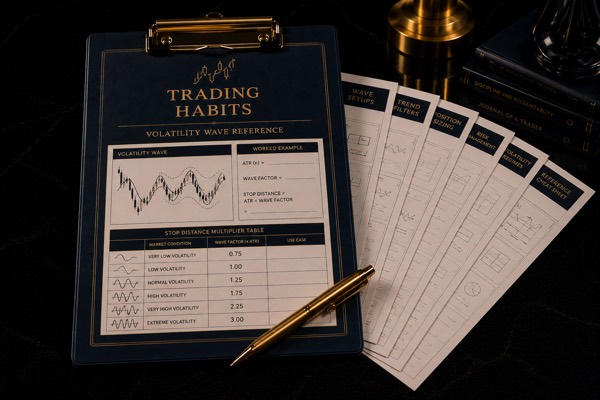
The ATR Position Sizing Reference Card
A quick-reference lookup for tying position size to volatility instead of a flat share count.
- Format PDF, 6 pages, print or read on screen
- Covers The ATR position-sizing formula, a worked example, and a multiplier reference table
- Includes A blank ATR Sizing Worksheet for your own trades
- Delivery Instant download right after checkout
Formula and structure only. Not a signal generator.
What's Inside
What's Inside The ATR Position Sizing Reference Card
- 01The standard ATR-based position sizing formula, explained in plain English with no jargon left undefined, so you're never nodding along at a term you'd struggle to actually apply.
- 02What each term in the formula actually means, including dollar risk, ATR, and stop-distance multiplier, so you can trust the number your platform spits out instead of just trusting the platform.
- 03One fully worked, clearly labeled illustrative example showing the math end to end, so you can check your own arithmetic against a known-correct answer before you size a genuine position off it.
- 04A reference table of common stop-distance multiples, worked through the same illustrative numbers so you can see how tightening or loosening the multiplier changes your size before you commit to one.
- 05Every example number is explicitly labeled illustrative, not a live quote for any genuine security, so you're never confused about what's a teaching number and what's actual data.
- 06A blank "My ATR Sizing Worksheet" for recording the account risk, ATR, multiplier, and size you actually used, so your sizing decisions leave a paper trail you can review later, not just a gut call you half-remember.
- 07A short "How To Use This Card" page up front, explaining what it does and doesn't do, so you're applying it correctly from the first read instead of guessing at its limits.
- 08One printable card, no login, no app, no subscription, so it sits on the desk next to your monitor and works even when your platform doesn't.
HABITS
★
Certificate of Guarantee
60-Day, No-Questions-Asked
If The ATR Position Sizing Reference Card doesn't earn a spot in your files, email us any time within 60 days of purchase for a full refund. No form to fill out. No reason required.
Instant Download
$6One-time payment. No subscription.
Order Now6-PAGE PDF · DELIVERED IMMEDIATELY AFTER CHECKOUT · 60-DAY GUARANTEE
Behind The Tool
Where The ATR Multiplier Convention Comes From
The Concept
Average True Range doesn't care what a stock "should" do. It measures how far price has actually traveled, bar to bar, accounting for gaps. A name that gaps and trends fifty cents a day earns a very different stop distance than one that grinds in a two-cent range, and ATR is the number that tells the difference automatically instead of assuming every stock behaves the same way.
Sizing off a multiple of that number, instead of a flat percentage or a flat share count, is what keeps a stop from sitting so close that normal noise triggers it, or so far that one loss undoes weeks of gains.
Where It Comes From
J. Welles Wilder introduced True Range and Average True Range in his 1978 book New Concepts in Technical Trading Systems, the same book that gave traders the RSI and the parabolic SAR. Wilder built True Range to solve a gap problem: a simple high-minus-low range understates volatility on any day a stock gaps from the prior close, so he defined it as the greatest of three values, current high minus low, high minus prior close, and low minus prior close, then smoothed that number into a moving average.
The 2x, 3x, and other stop-distance multipliers traders use today were popularized later, including work associated with the Turtle Traders' "N"-based position sizing in the 1980s, but the underlying ATR calculation is still exactly Wilder's original formula.
Same Dollar Risk, Different Position Size
Illustrative example, not a live quote: both positions size off the same $200 account risk and the same 2×ATR stop multiplier. The stock with three times the daily range gets roughly a third of the share count. Same dollar risk, different position size, because the stop moved with it.
Try It: Live ATR Stop & Size
Stop distance is ATR times the multiplier, not a fixed cent or percentage amount, so the stop widens on a volatile day and tightens on a quiet one automatically. Share count is dollar risk divided by that stop distance, same as the printed card walks through by hand.
Background only. The card itself works the formula end to end and gives you a blank worksheet for your own numbers.
Common Questions
Who invented Average True Range?
J. Welles Wilder, in his 1978 book New Concepts in Technical Trading Systems, the same book that introduced the RSI and the parabolic SAR.
Why not just use the high-minus-low range instead of True Range?
A simple high-minus-low range understates volatility on any day a stock gaps from the prior close. Wilder defined True Range as the greatest of three values, current high minus low, high minus prior close, and low minus prior close, specifically to fix that gap problem.
Where did the common 2x and 3x ATR stop multipliers come from?
They were popularized later, including work associated with the Turtle Traders' "N"-based position sizing in the 1980s. The underlying ATR calculation itself is still exactly Wilder's original 1978 formula.