Your Trade Log And Your Broker's Statement Don't Always Match. Most Months, You'll Never Notice The Gap.
A fee you didn't expect.
A quantity off by one share.
A fill that doesn't quite match what you wrote down.
Your trade log and your broker's statement drift apart in small ways, and most traders assume they match because they usually do.
Once a month, you'll put the two documents side by side and go category by category, trade counts, quantities, fees, dividends, cash balances, until every line either matches or gets flagged.
Anything that doesn't add up goes straight into the discrepancy log at the back, with a spot to note what you actually did about it, so it doesn't just sit there unresolved until you've forgotten why it happened.
Most months, everything ties out clean in fifteen minutes.
The one month it doesn't, you'll have caught it while the explanation is still easy to find, not six statements later when you're staring at a number you can't account for.
It doesn't connect to your brokerage account, and it doesn't check anything automatically.
You're the one holding both documents.
Anything you can't explain goes to your broker directly.
Not a guess.
A monthly habit.
Not an audit.
Not tax or legal advice.

The one month it doesn't, you'll have caught it while the explanation is still easy to find, not six statements later when you're staring at a number you can't account for.Jason Parker, Founder of Trading Habits
Introducing The Brokerage Statement Reconciliation Checklist
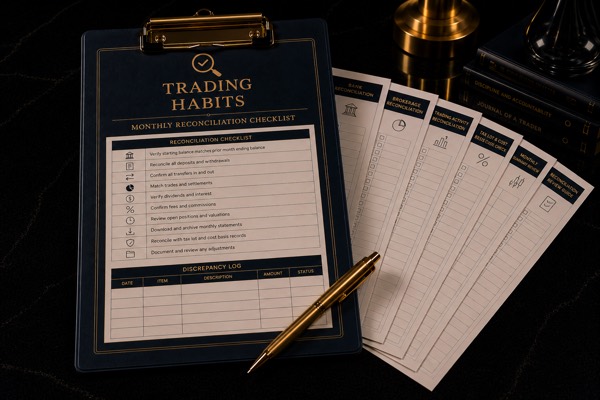
A Trading Habits Tool
The Brokerage Statement Reconciliation Checklist
A monthly routine for matching your own log to your broker's official statement.
- Format PDF, 6 pages, print or check off on screen
- Covers Trade activity, fees, dividends, and cash-balance reconciliation
- Includes A blank discrepancy log and monthly summary block
- Delivery Instant download right after checkout
A personal bookkeeping habit. Not an audit service.
What's Inside
What's Inside The Brokerage Statement Reconciliation Checklist
- 01A monthly, category-by-category comparison of your trade log against your broker's official statement, so nothing drifts out of sync for more than thirty days without you knowing it.
- 02Trade-activity checks covering every trade recorded on both sides, matching quantities, and matching fill prices, the exact spots where a fat-fingered order or a partial fill silently throws two records out of agreement.
- 03Cost and cash checks across commissions, fees, dividends, interest, and beginning and ending cash balances, the line items that erode an account a few dollars at a time without ever showing up as one alarming number.
- 04A general review pass for anything unrecognized, including trades, withdrawals, or transfers you didn't place, so an unauthorized transaction gets caught as one line item instead of a bigger problem.
- 05A blank discrepancy log with columns for the date found, what didn't match, and how it was resolved, so six months from now you can prove exactly what happened instead of trying to remember.
- 06A blank monthly summary block for tracking when reconciliation happened and whether anything needed follow-up, so the habit itself has a paper trail, not just the account.
- 07A short "How To Use This Checklist" page up front, explaining exactly what it does and doesn't do, so you're never guessing whether a gap needs your attention or your broker's.
- 08One printable checklist, no login, no app, no subscription, so the habit doesn't silently turn into one more account you have to remember to maintain.
HABITS
★
Certificate of Guarantee
60-Day, No-Questions-Asked
If The Brokerage Statement Reconciliation Checklist doesn't earn a spot in your files, email us any time within 60 days of purchase for a full refund. No form to fill out. No reason required.
Instant Download
$5One-time payment. No subscription.
Order Now6-PAGE PDF · DELIVERED IMMEDIATELY AFTER CHECKOUT · 60-DAY GUARANTEE
Behind The Tool
Where The Reconciliation Habit Comes From
The Concept
Reconciliation is a basic bookkeeping idea borrowed straight from accounting: two independently kept records of the same activity should agree, and when they don't, the gap gets investigated instead of ignored. For a trading account, that means your own log and your broker's official statement should show the same trades, the same fees, and the same ending balance, every month.
Most of the time they do. The value of doing this on a schedule is catching the month they don't, while the explanation is still easy to find.
Where It Comes From
Bank reconciliation as a formal accounting practice dates back to early double-entry bookkeeping, popularized in Luca Pacioli's 1494 treatise on the subject, and it's still taught as one of the first internal controls in any bookkeeping course today: compare your own records to an outside statement on a fixed schedule, not just when something feels wrong.
For brokerage accounts specifically, U.S. broker-dealers are required to send customers periodic account statements under SEC and FINRA recordkeeping rules, precisely so there's an independent, official document to check a personal log against. The checklist here is that same discipline, applied on your side of the relationship.
What Reconciling Actually Looks Like
Illustrative numbers, not a genuine account. Three rows tie out clean. The fourth doesn't, a $4.50 dividend gap, and that's exactly the kind of line the discrepancy log at the back exists to catch before it gets forgotten.
Try It: Reconcile Your Own Four Rows
Change any number and watch the count update live. This is the exact four-category comparison the checklist walks every month, trade count, fees, dividends, ending balance, catching the one line that doesn't tie out before it gets forgotten.
Background only. The checklist itself walks the full monthly comparison, category by category.
Common Questions
Is reconciling a trading account a trading-specific idea?
No, it's borrowed from basic accounting. Bank reconciliation as a formal practice traces back to Luca Pacioli's 1494 treatise on double-entry bookkeeping, and it's still one of the first internal controls taught in any bookkeeping course.
Why compare a personal log against the broker's statement at all?
U.S. broker-dealers are required under SEC and FINRA recordkeeping rules to send customers periodic account statements specifically so there's an independent, official document to check a personal log against.
What actually happens most months when you reconcile?
Most of the time the two records agree. The value of doing it on a schedule is catching the month they don't, while the explanation is still easy to find, not just when something already feels wrong.