Chasing The Entry By A Few Percent Can Turn Your 2:1 Setup Into A Coin Flip Before The Trade Even Starts. Here's The Exact Line.
There's a single number that decides whether your next trade is a genuine 2:1 setup or a coin flip, and it has nothing to do with the stock, the coin, or the setup you picked.
It's what happens in the handful of seconds between when you first saw the setup and when you actually clicked buy.
Traders call it the chase.
You'll get the exact percentage-point line where a textbook 2:1 setup collapses into a coin flip, before a single candle even closes, so you can check your own fills against an actual number instead of a feeling.
You'll see two separate simulations built for this report, one running 20,000 accounts and one running an exact probability calculation, land on the same conclusion from two completely different directions.
You'll walk through a well-known study of ten years of actual fund-investor behavior, the kind that tracks actual dollars, which found investors giving back a measured share of their own funds' returns for a reason that had nothing to do with picking the wrong fund.
You'll see what an 11-second difference in entry timing did to two otherwise-identical trades, and the exact dollar gap between two entry habits after 100 ordinary trades, no crash required.

You'll see what an 11-second difference in entry timing did to two otherwise-identical trades, and the exact dollar gap between two entry habits after 100 ordinary trades, no crash required.Jason Parker, Founder of Trading Habits
Introducing The Chasing Trade: the 20-page report laying out all of it, with the exact page number attached to every claim above.
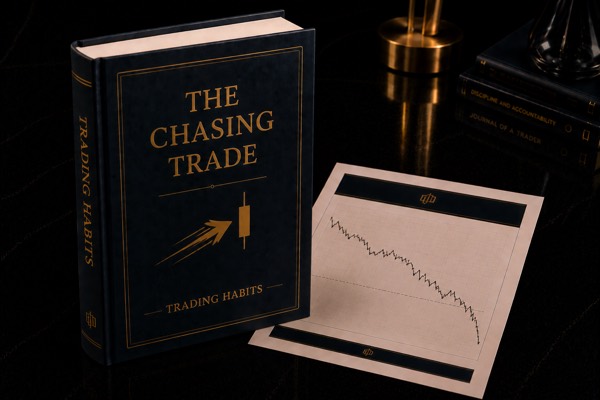
A Trading Habits Report
The Chasing Trade
What buying after the move already happened costs, worked out in full.
- Length 20 pages, with 8 original charts and two worked hypothetical case studies
- Author TradingHabits.com
- Format PDF, delivered as an instant download right after checkout
- Covers The research and psychology behind chasing an entry, the exact risk-to-reward math a chase destroys, a 20,000-account Monte Carlo simulation, and what to do instead
This report breaks down the research, the math, and the numbers on one specific decision.
What's Inside
20 Things This Report Actually Says
- 01The 4 exact situations that turn a plan into a chase, and the 1 thing they all have in common, the tell you can actually catch before the fill instead of after.Page 3
- 02Psychologists gave this feeling a name in 2013, and it has nothing to do with willpower, which means the fix isn't trying harder in the moment, it's removing the moment.Page 4
- 03The same buying pattern shows up in individual traders and Wall Street fund managers alike, proven in a 1999 study, proof this isn't a beginner habit you outgrow with more screen time.Page 4
- 04How a 10-year study found investors giving back 15% of their own funds' gains without a single bad pick, the cost showed up in timing, not selection.Page 5
- 05The exact gap between what bitcoin ETFs returned and what the average investor actually walked away with, January 2024 through June 2026, the same math your own account runs live.Page 6
- 06Why a 2:1 setup and a 1:1 setup can be the exact same trade, seconds apart, so you can see how much of your edge is decided before you even click buy.Page 7
- 07The precise chase percentage where a winning trade's reward hits zero before a single candle closes, a hard number to check your own fills against.Page 7
- 08What a backtest says versus what your actual fill said, laid out on one curve, the gap between the strategy you tested and the trade you actually took.Page 8
- 09The term researchers use for why a stock that already went up gets easier to justify buying, name the excuse and it stops working on you.Page 9
- 10The chart showing exactly where new investor money goes, and where it refuses to go, and which side of that line your last entry landed on.Page 10
- 11A $5,000 account, a $50 risk budget, and a 2% chase, walked through dollar by dollar to its breakeven-minus ending, the arithmetic behind a trade that looked fine going in.Page 11
- 12Same stock, same setup, same day, what an 11-second difference in entry timing actually did to the account line from open to close.Page 12
- 13The one decision a news-spike trade got backward, and it wasn't the entry, the mistake traders blame least is often the one that cost the most.Page 13
- 14-$50 versus +$76 on the identical stock, the identical day, the single variable isolated that separated the loss from the win.Page 13
- 15Two modeled traders, one number apart in expectancy, what that single difference compounds into once it's run across enough trades, not just one.Page 14
- 1620,000 disciplined accounts. 20,000 chaser accounts. Not one exception either way, this isn't a tendency, it's a rule the simulation never once broke.Page 15
- 17Why a losing streak shows up faster for one entry habit than the other, and it isn't bad luck, which means it's fixable, not something to just ride out.Page 16
- 18The exact dollar gap between two entry habits after 100 ordinary trades, no crash required, what a normal year costs without you noticing, not a disaster scenario.Page 17
- 19The 2 numbers traders admit about their own rule-breaking, straight from industry survey data, a gut check for how your own habit stacks up.Page 18
- 20The 1 line you can pre-decide before the trigger even prints, and why it has to be written down first, so the decision gets made before the chase feeling ever shows up.Page 19
HABITS
★
Certificate of Guarantee
60-Day, No-Questions-Asked
If The Chasing Trade doesn't earn its place on your desk, email us any time within 60 days of purchase for a full refund. No form to fill out. No reason required.
Instant Download
$7One-time payment. No subscription.
Order Now20-PAGE PDF · DELIVERED IMMEDIATELY AFTER CHECKOUT · 60-DAY GUARANTEE
Behind The Report
FOMO And Herding

By the time the move is obvious enough to chase, the herd is already most of the way there.
The Concept
FOMO is the discomfort of watching something move without you in it. In a trading account it turns into an entry taken after the setup that justified it is already gone, at a price the original plan never would have accepted.
Herding is the closely related habit of buying because other people are buying, using their action as a stand-in for a signal of your own.
Where It Comes From
FOMO existed as internet slang for years before psychologists gave it a formal definition. Andrew Przybylski, Kou Murayama, Cody DeHaan, and Valerie Gladwell published the first academic measurement of it in a 2013 Computers in Human Behavior paper, building a scale to measure the feeling instead of only naming it.
Herding in markets has a longer paper trail. John Nofsinger and Richard Sias documented it directly among institutional and individual investors in a 1999 Journal of Finance study, and Erik Sirri and Peter Tufano's 1998 Journal of Finance research showed the same chasing behavior in how money flows into mutual funds right after their best returns, arriving exactly when the edge is most likely already spent.
What Chasing An Entry Does To Risk-to-Reward
Illustrative setup: entry $50, stop $48, target $56, a 3:1 plan. Buy at $52 instead and the same stop and target now risk $4 to make $4. Buy at $54 and it's risking $6 to make $2. The stop and target never moved. Only the entry did.
Try It: Watch The Ratio Collapse As You Chase
Same setup as the chart: stop at $48, target at $56, entry planned at $50 for a 3:1 trade. Drag the slider to chase the entry higher toward that same target. The stop and target never move. Only the ratio does.
Background only. The report itself works the exact risk-to-reward math a chased entry destroys, and runs it across a 20,000-account simulation.
Common Questions
Is FOMO a genuine, measured thing or just internet slang?
Both, in a sense. FOMO existed as internet slang for years before psychologists Andrew Przybylski, Kou Murayama, Cody DeHaan, and Valerie Gladwell built the first academic scale to measure it, in a 2013 Computers in Human Behavior paper.
Does herding show up in markets specifically, not just individual traders?
Yes. John Nofsinger and Richard Sias documented herding among institutional and individual investors in a 1999 Journal of Finance study, and Erik Sirri and Peter Tufano found the same chasing pattern in money flowing into mutual funds right after their best returns.
How much does chasing an entry actually change the trade's math?
A lot, without the stop or target ever moving. A planned $50 entry with a $48 stop and $56 target is a 3:1 trade. Buy at $52 instead and the same stop and target become a 1:1 trade. Buy at $54 and it's 0.33:1.
Sources & Further Reading
-
Przybylski, A. K., Murayama, K., DeHaan, C. R. & Gladwell, V. (2013). “Motivational, Emotional, and Behavioral Correlates of Fear of Missing Out.” Computers in Human Behavior, 29(4), 1841-1848.
Gave FOMO its first academic measurement, the discomfort this report's chase-versus-wait slider turns into a risk-to-reward number.
-
Nofsinger, J. R. & Sias, R. W. (1999). “Herding and Feedback Trading by Institutional and Individual Investors.” The Journal of Finance, 54(6), 2263-2295.
Documented herding among institutional and individual investors alike, the buy-because-others-are-buying instinct behind a chased entry.
-
Sirri, E. R. & Tufano, P. (1998). “Costly Search and Mutual Fund Flows.” The Journal of Finance, 53(5), 1589-1622.
Found the same chasing pattern in mutual fund flows: money arriving right after a fund's best returns, right when the edge is most likely already spent.