Your Stop Gets Touched. You Check One More Thing Before You Get Out. That "One More Thing" Is The Most Predictable Part Of The Entire Trade.
There's a specific moment in almost every held-too-long loser that has nothing to do with the setup, the entry, or the stop level itself.
It's the pause. The one where price already hit your line, and instead of clicking the exit, you open a tab.
Psychologists have a name for what happens next, and it isn't due diligence.
You'll see a 1987 study that named the exact strategy your brain runs the moment it's testing "is this trade still good" instead of testing whether it's already over, and why that search is rigged to succeed before it even starts.
You'll walk through two case studies, a $4,000 long and a $10,000 short, on completely unrelated names, where the same single-data-point search produced a loss more than 2.9 times the planned stop, both times.
You'll see a 3,000-account simulation where two groups trade the identical setup, the identical size, and the identical edge, and one group's habit of "checking one more thing" turns a modestly profitable year into a mostly-blown one.
You'll get the 5-question pre-mortem that removes the search's power before the trade is ever placed, and the 5-line audit for finding this exact pattern already sitting in your own trade log.

Two accounts, opposite directions, unrelated names: the same single-data-point search produced a loss more than 2.9 times the planned stop, both times.Jason Parker, Founder of Trading Habits
Introducing The Confirmation Bias Trade: the 20-page report laying out all of it, with the exact page number attached to every claim above.
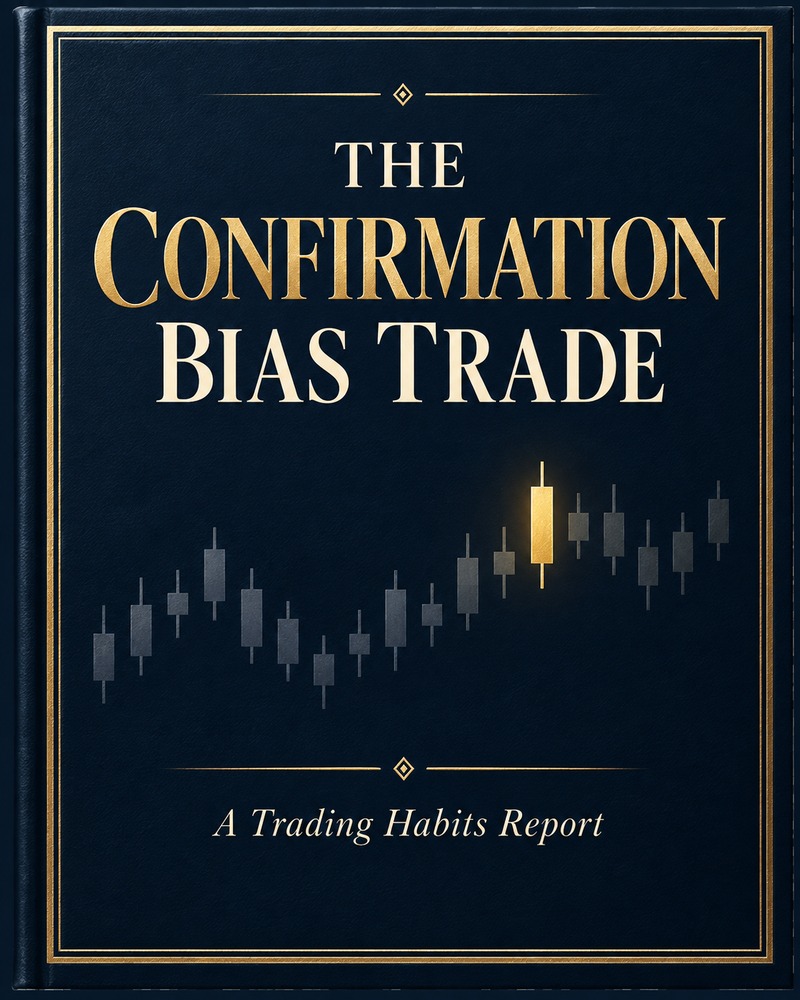
A Trading Habits Report
The Confirmation Bias Trade
Why the one piece of evidence you go looking for after a stop is touched is the least trustworthy evidence you'll see all week.
- Length 20 pages, with 5 original vector charts and two worked case studies
- Author TradingHabits.com
- Format PDF, delivered as an instant download right after checkout
- Covers The research behind confirmation bias in a live trade, the exact funnel from stop-touch to override, a 3,000-account simulation, a 5-question pre-mortem, and a 5-line audit for your own log
This report breaks down the research, the case studies, and the numbers on one specific decision.
What's Inside
20 Things This Report Actually Says
- 01The exact difference between research done before a trade and the search that starts the moment a stop is touched, and why they only look the same from the outside.Page 3
- 02A 1987 study named the exact strategy traders use without knowing it, when they test whether a losing trade is "still good" instead of testing whether it's already over.Page 4
- 03Why the search for a reason to hold almost never comes back empty, and what that says about how reliable the evidence actually is.Page 4
- 04A 1998 review of decades of research across law, medicine, and everyday reasoning found the exact same bias gets stronger the moment someone has money on the line.Page 4
- 05A 1979 study showed two people the identical piece of evidence and got two completely opposite verdicts on how credible it was.Page 5
- 06What that same study means for a stop-loss specifically, and why "let me check one thing first" already broke the reason a stop works at all.Page 5
- 07The four-step funnel this report ran on 3,000 simulated accounts, from stop touch to override, and the exact percentage that makes it to the final step.Page 6
- 08A $4,000 account, a $120 stop, and one analyst note out of six published that week. What the final loss came out to.Page 7
- 09The exact multiple of the planned stop the account above actually lost, once the search returned that one note.Page 7
- 10A $10,000 short position, a single lighter-volume green candle, and what it cost to read that candle as "exhaustion."Page 8
- 11The two accounts on pages 7 and 8 traded in opposite directions on unrelated names. What connects both final numbers exactly.Page 8
- 12What a 3,000-account simulation was built to isolate, with every input except one held completely identical between two groups.Page 9
- 13The exact median account value, in dollars, that separated the group that honored every stop from the group that paused to look for one more data point.Page 10
- 14The average maximum drawdown for each group across the simulated year, and how much wider the gap gets at the 90th percentile.Page 10
- 15The share of all 3,000 accounts in each group that fell below half their starting equity, and how many times higher that number was for one group.Page 11
- 16The average dollar cost of a single overridden stop, beyond the 1R that was already priced in before the override.Page 11
- 17What this simulation deliberately does not claim about your own setup, and the one narrow claim it does make instead.Page 12
- 18The one pre-trade question, out of five, that this report calls "load-bearing," and why answering it in advance changes what a found data point can do to you later.Page 13
- 19The five-line audit for finding this exact pattern already sitting in your own last 20 closed trades.Page 14
- 20The three legitimate reasons this report lists for actually moving a stop, and the one test that separates them from everything else.Page 15
HABITS
★
Certificate of Guarantee
60-Day, No-Questions-Asked
If The Confirmation Bias Trade doesn't earn its place on your desk, email us any time within 60 days of purchase for a full refund. No form to fill out. No reason required.
Instant Download
$7One-time payment. No subscription.
Order Now20-PAGE PDF · DELIVERED IMMEDIATELY AFTER CHECKOUT · 60-DAY GUARANTEE
Behind The Report
Confirmation Bias And The Positive Test Strategy
The funnel narrows, but not by much: once a stop is touched and a search is run, this report's own simulation found evidence gets "found," and used, more often than not.
The Concept
Confirmation bias is the tendency to search for, interpret, and recall information in a way that confirms a belief you already hold. In a trade, the belief is "this thesis is still good," and the search runs hardest exactly when a stop level says otherwise.
Klayman and Ha's positive test strategy describes the specific mechanism: people testing a hypothesis look for cases that would confirm it, not cases that would falsify it. Applied to a held trade, that means hunting for bullish evidence on a long instead of weighing the strongest bearish case available.
Where It Comes From
Joshua Klayman and Young-Won Ha published the positive test strategy in a 1987 issue of Psychological Review. Raymond Nickerson's 1998 review in Review of General Psychology surveyed decades of confirmation-bias research across law, medicine, and science and found the bias strengthens once a person has committed to a position.
Charles Lord, Lee Ross, and Mark Lepper's 1979 study in the Journal of Personality and Social Psychology, "Biased Assimilation and Attitude Polarization," showed the identical evidence rated as credible or flawed purely based on the belief already held, discussed in full on page 5 of the report.
Median Account Value After A Simulated Year, Identical Edge, One Habit Changed
Illustrative modeled comparison from this report's own 3,000-account simulation: identical starting equity, identical setup, identical position size, only the stop-honoring habit changed.
Try It: Watch The Final Loss Grow As The "Extra Look" Gets More Convincing
Modeled from this report's two case studies (pages 7-8): a 1.0x outcome when the stop is honored, climbing toward a 3.0x outcome as the found evidence feels more conclusive and the exit gets pushed further out. Drag the slider to see the modeled multiple in between.
Background only. The report itself works the exact case-study math and the 3,000-account simulation behind these numbers.
Common Questions
Isn't checking the news after a stop is touched just being thorough?
Thoroughness happens before the position exists, when every argument gets equal weight. A search that starts only once a stop is touched and stops the moment it finds one supporting point is a positive test strategy, the exact pattern Klayman and Ha documented in 1987, not balanced research.
Does this only apply to news and headlines?
No. The evidence found is just as often a single candle, a level on a chart, or a comment from someone else who's also in the trade. Nickerson's 1998 review covers all of it under the same mechanism: selectively weighting anything that agrees with a position already held.
What if the confirming evidence turns out to be right?
Some overridden stops will work out; that's true of any biased process applied to a noisy market. The report's simulation already prices in every case where the override worked, and the bias-driven group still finishes with a lower median outcome and a far higher blown-account rate.
Sources & Further Reading
-
Klayman, J. & Ha, Y. (1987). “Confirmation, Disconfirmation, and Information in Hypothesis Testing.” Psychological Review, 94(2), 211-228.
The positive test strategy this report's stop-touch-to-override funnel is built from.
-
Nickerson, R. S. (1998). “Confirmation Bias: A Ubiquitous Phenomenon in Many Guises.” Review of General Psychology, 2(2), 175-220.
The review establishing how confirmation bias strengthens once a person has committed to a position.
-
Lord, C. G., Ross, L., & Lepper, M. R. (1979). “Biased Assimilation and Attitude Polarization: The Effects of Prior Theories on Subsequently Considered Evidence.” Journal of Personality and Social Psychology, 37(11), 2098-2109.
The finding that identical evidence gets rated differently depending on the belief already held.