A Trading Habits Tool
Stop Doing Session-Overlap Math In Your Head At 6 AM
There's one overlap window every trading day where London, New York, and Tokyo volume stacks, and most traders find it by accident, at 6 AM, doing the math in their head.
You'll get stock exchange hours for nine major markets, all four forex sessions in UTC, and the three overlap windows that actually carry volume, on one sheet instead of six browser tabs.
You'll get a plain note on how CME futures run close to 24 hours with their own daily maintenance break, and a blank last page to write in your own hours once you've checked them against your broker.
You'll stop guessing whether London and New York are both open right now and start knowing at a glance.
Daylight saving doesn't help.
The US, UK, and EU don't even shift on the same weekend, which is exactly the kind of thing that's easy to get wrong at 6 AM.
Print it, pin it, stop doing the math in your head.

There's one overlap window every trading day where London, New York, and Tokyo volume stacks, and most traders find it by accident, at 6 AM, doing the math in their head.Jason Parker, Founder of Trading Habits
Introducing The Global Market Hours Cheat Sheet.
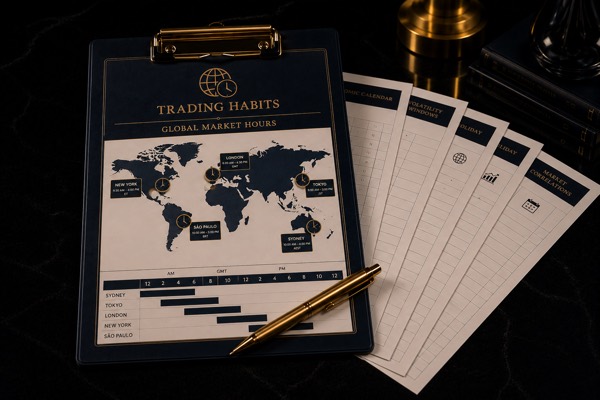
The Global Market Hours Cheat Sheet
Stock exchange and forex session times, in one reference sheet.
- Format PDF, 6 pages, opens in any PDF reader
- Pages How to use it, stock exchanges, forex sessions, futures note, my trading windows
- Coverage 10 stock exchanges, 4 forex sessions, 3 overlap windows
- Delivery Instant download right after checkout
Reference only. Verify against your own broker before you plan around it.
What's Inside
What's Inside The Global Market Hours Cheat Sheet
- 01Regular session hours for nine major stock exchanges, in both local time and the exchange's own time zone, so you stop opening a broker app just to check if a market is live.
- 02All four forex sessions in UTC, so you're not converting six time zones in your head before the market opens, and you're not the trader who misses a session because the math was wrong.
- 03The three forex overlap windows, including the London/New York window that carries the heaviest volume of the day, so you can plan around when the tape is actually worth trading instead of when it's technically open.
- 04A plain-language note on how daylight saving shifts these times, and why the US/UK/EU gap moves for a few weeks twice a year, the exact stretch that catches traders off guard every spring and fall.
- 05A short page on CME futures hours and the daily maintenance window, without pretending every contract behaves identically.
- 06A blank My Trading Windows worksheet for writing down the specific hours you actually trade, turning a generic reference sheet into your own personal schedule.
- 07No macros, no software, no login. Print it or keep it open on a second screen.
- 08Reference only. Hours are set by exchanges and brokers and can change without notice.
HABITS
★
Certificate of Guarantee
60-Day, No-Questions-Asked
If The Global Market Hours Cheat Sheet doesn't earn its place on your desk, email us any time within 60 days of purchase for a full refund. No form to fill out. No reason required.

Backed personally by Jason Parker, founder of Trading Habits. He built this himself, covered by the same guarantee above.
Instant Download
$5One-time payment. No subscription.
Order NowPDF · DELIVERED IMMEDIATELY AFTER CHECKOUT · 60-DAY GUARANTEE
Behind The Tool
Where These Session Times Come From
The Concept
A trader watching one clock eventually gets surprised by another one. US equities run on a fixed 6.5-hour session tied to Eastern time. Currencies trade almost continuously across a handoff of regional sessions that pass the baton as the earth turns. Neither schedule adjusts for where the trader happens to be sitting, and daylight saving doesn't move the two together, since the US, UK, and EU each shift their own clocks on different weekends.
Liquidity isn't constant even inside a session that's technically open. It concentrates in the hours when two major markets overlap and thins out everywhere else, and a fill that looked fine on a demo account can come back at a noticeably worse price during one of the quiet stretches.
Where It Comes From
NYSE's 9:30 a.m. to 4:00 p.m. Eastern session has held since September 1985, when the exchange pushed its opening bell back a half hour from 10:00 a.m., a change made to line up more of the trading day with European markets.
Forex never had a single opening bell to move, because it never had a single exchange to move it at. The modern floating-rate currency market traces to August 1971, when the US suspended the dollar's convertibility to gold, the move known as the Nixon Shock, and to March 1973, when the Bretton Woods system of fixed exchange rates broke down for good and major currencies were left to float against each other. Trading currencies against each other turned into an over-the-counter, bank-to-bank market with no central exchange and no fixed hours, structurally different from a stock exchange from day one. The Bank for International Settlements' 2025 Triennial Survey put daily global forex turnover at $9.51 trillion, with the UK alone handling more than a third of it, which is why the stretch when London and New York are both open is consistently the busiest window of the trading day.
Futures moved toward round-the-clock trading later, and more gradually. CME launched Globex, the first electronic trading platform for financial derivatives, on June 25, 1992, starting with three currency contracts and one Treasury note contract running in the overnight hours outside the exchange's traditional pit session. Electronic volume didn't pass floor volume until 2004, but Globex is the reason a CME futures contract today can trade close to 24 hours with only a short daily maintenance break, instead of going dark the moment the pit closed for the day.
Live: Which Markets Are Open Right Now
UTC time: —
Stock Exchanges
Forex Sessions
Reads your device's clock and checks it against each market's regular published session, using each market's own local time zone so daylight saving is handled without any extra input. It doesn't account for market holidays, early closes, or the midday trading halts that Tokyo, Hong Kong, and Shanghai each observe. Confirm against your broker before you plan around it, the same rule the sheet itself follows.
Common Questions
Why does NYSE open at 9:30 instead of some other time?
It hasn't always. The exchange pushed its opening bell back a half hour from 10:00 a.m. in September 1985, a change made to line up more of the trading day with European markets.
Why doesn't forex have a single opening bell like a stock exchange?
Because it never had one exchange to move it at. The modern floating-rate currency market traces to August 1971, when the U.S. suspended the dollar's convertibility to gold, and March 1973, when the Bretton Woods system of fixed exchange rates broke down for good. Currencies have traded bank-to-bank over the counter ever since.
How much money actually moves through forex each day?
The Bank for International Settlements' 2025 Triennial Survey put daily global forex turnover at $9.51 trillion, with the UK alone handling more than a third of it, which is why the London/New York overlap is consistently the busiest window of the trading day.