Roughly 1 In 10 Option "Pins" Are Pure Chance. This Report Isolates The Rest.
You're about to find out exactly how much of "max pain" is real, and how much is folklore repeated on trading forums until it sounded like fact.
You'll get the full breakdown behind the $7.1 trillion that expired in a single session on December 19, 2025, the largest witching day ever recorded, plus the two records before it that make the climb impossible to wave off.
You'll get both peer-reviewed studies on strike-price clustering laid out side by side, the 2005 Journal of Financial Economics paper and the 2021 follow-up, with the trading-forum exaggeration stripped out and the actual percentage-point differences left in.
You'll get dealer gamma exposure explained in plain English, the GEX mechanic institutional desks have tracked since 2016, including why the same setup pins a price on one expiration and blows straight through it on the next.
And you'll get a number nobody else has published: an original 20,000-run simulation built from scratch for this report, isolating how much of a near-strike close is ordinary statistical noise before any gamma-hedging story gets added on top.

And you'll get a number nobody else has published: an original 20,000-run simulation built from scratch for this report, isolating how much of a near-strike close is ordinary statistical noise before any gamma-hedging story gets added on top.Jason Parker, Founder of Trading Habits
Introducing The Options Expiration Report
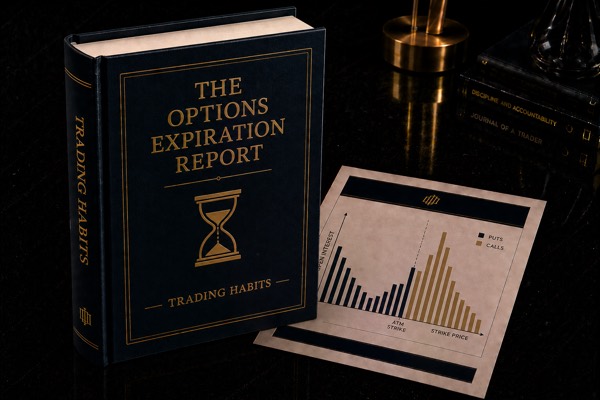
A Trading Habits Report
The Options Expiration Report
What max pain theory actually predicts, what published research found, the mechanics of dealer gamma, the $7.1 trillion record witching day, and an original simulation of how much of a "pin" is ordinary chance.
- Length 20 pages, with 6 original charts and a 20,000-run simulation
- Author TradingHabits.com
- Format PDF, delivered as an instant download right after checkout
- Covers expiration mechanics, max pain theory, the published academic research, dealer gamma, the record December 2025 witching day, and an original chance-versus-pin simulation
No stock is picked, ranked, or listed anywhere in this report. SPY appears exactly once, as a fully hypothetical mechanics example, never as a recommendation.
What's Inside
20 Things This Report Actually Says
- 01The actual difference between a routine weekly expiration and one of the four triple witching dates a year, so you know which weeks actually deserve extra caution.Page 4
- 02Why 0DTE contracts now make up 65 percent of total SPX options volume, and what that shift means for how twitchy the market gets into any close.Page 4
- 03Schaeffer's own 14-event data set on triple-witching Thursdays and Fridays, so you're working from real averages instead of a gut feeling.Page 5
- 04The exact $7.1 trillion breakdown behind December 19, 2025's record expiration, per Goldman Sachs, the specific number every headline that week rounded off.Page 6
- 05How that record climbed three quarters in a row, from $5.1 trillion to $6.5 trillion to $7.1 trillion, and what the trend line says about the next one.Page 6
- 06Open interest and strike price, the two raw numbers every theory in this report starts from, so nothing downstream feels like a black box.Page 7
- 07Max pain theory, explained the way it's claimed to work, no hand-waving, so you can judge it yourself instead of repeating it secondhand.Page 8
- 08The 2005 Journal of Financial Economics study: 19 percent clustering versus 18 percent, and what that one-point, $9 billion gap actually means for you.Page 9
- 09A 2021 "No Max Pain, No Max Gain" paper, and why its own authors call the effect a reversal, not a magnet, the distinction most retail explainers skip.Page 9
- 10The honest summary of both studies lined up together, without the trading-forum exaggeration, so you stop overweighting a theory the data only partly backs.Page 10
- 11Dealer gamma exposure (GEX), the metric SqueezeMetrics first published in March 2016, explained in plain English instead of desk jargon.Page 11
- 12Long gamma versus short gamma, and why the same market can either pin a price or blow through it, the fork every expiration-day read needs to account for.Page 11
- 13The "gamma cliff": why some of the sharpest post-expiration moves show up with no headline attached, and how to stop being blindsided by one.Page 12
- 14Why monthly expiration carries less weight than it used to, in one chart, so you can stop treating every third Friday the same.Page 13
- 15A fully hypothetical, hand-worked SPY walkthrough tying every mechanic in the report together into one example you can actually follow start to finish.Page 14
- 16An original simulation, 20,000 runs deep, built from scratch in Python and NumPy for this report, a number no other source has published.Page 15
- 17The result: how much of a near-strike close is pure statistical noise, before gamma ever enters the picture, the baseline every max-pain claim should be measured against.Page 15
- 18What assignment and exercise actually obligate each side of a contract to do into expiration, so settlement never catches you off guard.Page 17
- 19Eight questions to run before you trade into any expiration date, a checklist you can use on your very next one.Page 18
- 20Seven sources, from the original 2005 academic paper to Cboe's own 2026 earnings materials, listed with exactly what each one backs up, so you can verify every claim yourself.Page 19
HABITS
★
Certificate of Guarantee
60-Day, No-Questions-Asked
If The Options Expiration Report doesn't earn its place on your desk, email us any time within 60 days of purchase for a full refund. No form to fill out. No reason required.

Backed personally by Jason Parker, founder of Trading Habits. He built this himself, covered by the same guarantee above.
Instant Download
$9One-time payment. No subscription.
Order Now20-PAGE PDF · DELIVERED IMMEDIATELY AFTER CHECKOUT · 60-DAY GUARANTEE
Behind The Report
Three Records In A Row, And One Number Still Missing From The Debate
From $5.1 Trillion To $7.1 Trillion
Goldman Sachs pegged the notional value expiring on December 19, 2025 at roughly $7.1 trillion, including about $5 trillion tied to S&P 500-linked contracts, an estimated 10.2 percent of the entire Russell 3000's market capitalization in a single session.
That broke the prior record of roughly $6.5 trillion set in June 2025, which had itself broken the approximately $5.1 trillion record from December 2024. Three consecutive quarters, each one bigger than the last.
What Nothing Had Isolated Yet
The academic research behind Section 6 measured actual clustering at strike prices. It never isolated how much of that comes from pure chance alone, before any gamma-hedging story gets added on top.
So this report built its own simulation from scratch: 20,000 independent random walks, stated assumptions, zero hedging behavior modeled. No stock, fund, or ticker is picked, ranked, or listed anywhere in this report or on this page.
Three Consecutive Records, In One Chart
A simplified rendering of the record-climb chart discussed on page 6 of the report. Background only. The report itself covers the exact sourcing behind every one of these figures.
Try It: An Illustrative Move-Size Odds Calculator
A simple normal-distribution estimate using the same random-walk math behind the report's own Section 11 simulation, not a forecast, not gamma-adjusted, and not tied to any actual security. This estimates the odds of finishing within a stated distance of today's hypothetical price after N days. It does not model dealer hedging, open interest, or any specific stock. The full 20,000-run pin-distance simulation is in the report.
Background only. Nothing on this page or in this report is a recommendation to buy, sell, or hold any security, or to trade around any specific expiration date.
Common Questions
Does max pain theory actually work?
Partly, and much less dramatically than trading-forum posts suggest. A 2005 Journal of Financial Economics study found genuine but modest clustering at strike prices on expiration dates, about one percentage point more than non-expiration Fridays. One more recent paper found a stronger effect concentrated almost entirely in small-cap, thinner-volume stocks, and its own authors describe the pattern as a reversal effect, not proof that option positioning pulls price toward a strike. The report covers both studies directly, on page 9.
What is dealer gamma, in plain English?
It's an estimate of how much stock market makers need to buy or sell to stay hedged as prices move, aggregated across every strike they're positioned in. When dealers are net long gamma, their hedging tends to lean against a move, which can support price pinning near a heavily traded strike. If they're net short gamma instead, hedging leans with the move, which can amplify it. The report walks through the full mechanism, with a diagram, on page 11.
Where does the "$7.1 trillion" figure come from?
Goldman Sachs's own notional-value estimate for the December 19, 2025 triple witching, as reported in contemporaneous financial press coverage: roughly $7.1 trillion total, including about $5 trillion in S&P 500-linked contracts and $880 billion in single-stock options. It broke the prior record of $6.5 trillion set only six months earlier. The full breakdown is on page 6.
Does this report tell me how to trade an expiration date?
No, and it isn't trying to. It lays out the mechanics, the published research, dealer gamma, the record dollar figures, and an original simulation, then hands you an eight-question checklist on page 18 to run before you trade into your own next expiration. No stock is picked, ranked, or listed anywhere in it, and SPY appears exactly once, as a fully hypothetical mechanics example, never as a recommendation.