A Trading Habits Course
The Greeks, Gamma Squeezes, and the $500-to-$5,000 Math, Worked Honestly Instead Of Screenshotted
Somewhere on Reddit right now, someone is screenshotting a $500 account that turned into $9,400 in one Tuesday afternoon.
0DTE calls.
SPY, an hour before close.
The screenshot is probably genuine.
What almost never gets posted is the string of accounts that took the same trade before that one screenshot happened, same setup, same conviction, zero to broke in about the time it takes to eat lunch.
You'll get twelve modules that teach the other version of options: Greeks that mean something the moment you read a chain, gamma squeeze mechanics explained the way a market maker would explain them, unusual options activity read sweep by sweep for what it actually is, and the specific math behind turning $500 into $5,000 run through a probability table instead of a feeling.
You'll stop guessing what theta is doing to your extrinsic value in the final ninety minutes before expiration and start knowing the number, because you worked it yourself.
Twelve modules.
No signals.
No calls to buy.
Only the mechanics, the math, and the discipline that decide whether an options account survives its own multiplier.
Introducing The Options Flow System.
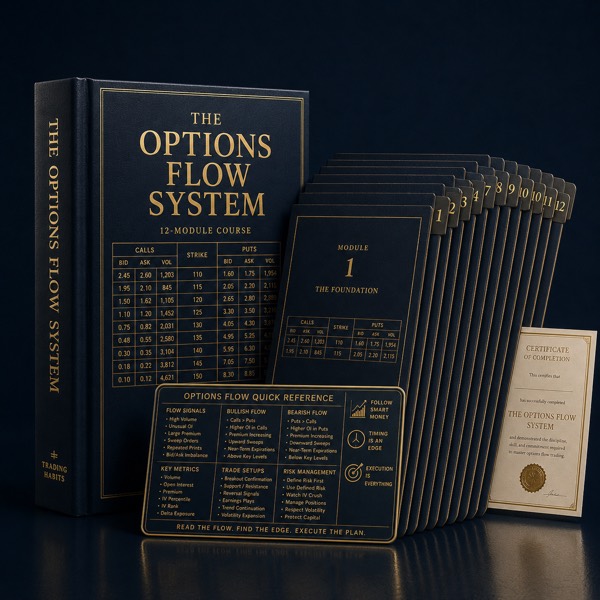
The Options Flow System
0DTE mechanics, gamma squeezes, options flow, and the risk math behind every contract you'd ever click "buy" on.
- Length 12 modules, built for genuine depth, not padding
- Format A private, self-paced course page with working calculators built into the lessons, not only links out to them, plus a searchable glossary covering every term from all 12 modules and a one-page printable cheat sheet of every formula, Greek, and checklist
- Access Instant, right after checkout, yours to re-read for good
- Covers Options mechanics and the Greeks, 0DTE decay, SPY/QQQ intraday structure, gamma squeezes, options flow, IV crush, spreads, position sizing, and the $500-to-$5,000 math worked honestly
- Author TradingHabits.com
Built for one job: understanding exactly what an option is doing to your risk before you're the one holding it.



Try It First
One Flow Read Before You Buy
This is one drill from the 15-scenario Setup Practice Lab in Module 4, not the whole lab. Watch the candle build the way SPX and QQQ actually move around a print, call Buy or Sell before the outcome shows, then see what happened. It's a real, scored drill running right here, not a screenshot of the module.
What's Inside
The 12 Modules
- 01What you're buying: calls, puts, contracts, and what exercise and assignment trigger. You stop treating a contract as a lottery ticket and start understanding exactly what obligation you're on the other side of.Module 1
- 02The Greeks in plain English: delta, gamma, theta, and vega, and what each one is doing to your position right now. You read your own open position the way a market maker reads it, instead of only watching the P&L number move and guessing why.Module 2
- 030DTE, decoded: what same-day expiration changes about theta, gamma, and the clock itself. You know exactly how fast an extrinsic dollar is bleeding out of a same-day contract instead of finding out the hard way at 3:45pm.Module 3
- 04Trading SPY and QQQ intraday: the opening print, VWAP, and the levels that hold. You get a repeatable read on the two instruments almost every 0DTE trade is actually built on, instead of a fresh guess every morning.Module 4
- 05Gamma squeezes: the dealer hedging feedback loop, mechanism by mechanism. You see the mechanical reason a squeeze accelerates instead of just recognizing one after it's already happened.Module 5
- 06Unusual options activity and options flow: sweeps, blocks, open interest, and what's signal versus noise. You stop reacting to every alert that pings your phone and start filtering for the handful that actually mean something.Module 6
- 07IV, IV rank, and the IV crush trap: why a correct direction call can still lose money. You stop losing on trades where you called the move right, because you'll finally know the specific mechanism that beat you.Module 7
- 08Spreads versus naked options: capping risk without abandoning the setup. You get a structure for taking the same idea with defined risk, instead of only knowing the all-or-nothing version.Module 8
- 09Position sizing for a small options account: the math that decides how many contracts is too many. You size a position off a number you calculated, not off how confident the setup feels in the moment.Module 9
- 10The $500-to-$5,000 math: the actual probability table behind account-doubling goals. You see the honest odds behind the goal everyone chases, including the version where the math says don't.Module 10
- 11The five behavioral patterns that blow up options accounts, and how each one starts small. You recognize your own next mistake while it's still small enough to stop, instead of after the account is gone.Module 11
- 12An 8-week path from paper trading to live 0DTE size, gated by rules, not by confidence. You get a specific, dated sequence for earning your way into real size, instead of a vague promise to "start small."Module 12
+ Setup Practice Lab in Module 4: 15 interactive candlestick drills on SPY, QQQ, and the indices behind them. Watch a chart build, call Buy or Sell before the next candle prints, then see what actually happened.
Unusual flow tells you something is happening. It doesn't tell you which way the crowd is actually leaning until the next few prints do, which is exactly what the Practice Lab drills you on before you ever click buy with real size.
HABITS
★
Certificate of Guarantee
60-Day, No-Questions-Asked
If The Options Flow System doesn't earn its place in your process, email us any time within 60 days of purchase for a full refund. No form to fill out. No reason required.
Backed personally by Jason Parker, founder of Trading Habits. He built this himself, covered by the same guarantee above.
Instant Access
$299One-time payment. No subscription.
Get Instant Access12-MODULE DIGITAL COURSE · DELIVERED IMMEDIATELY AFTER CHECKOUT · 60-DAY GUARANTEE
Behind The Course
How "0DTE" Became a Five-Day-a-Week Habit
The First Listed Options
The Chicago Board Options Exchange opened for trading on April 26, 1973, with 911 contracts changing hands on only 16 underlying stocks. Every one of them was a call. Put options weren't approved for listed trading until four years later, in 1977.
The Black-Scholes options pricing model was published that same year, 1973, giving traders and market makers their first widely usable framework for what a contract should be worth.
Same-Day Expiration, Every Day
For most of options trading history, an underlying index like the S&P 500 only expired on specific days each week. Cboe added Tuesday expirations to SPX options on April 18, 2022, and Thursday expirations followed on May 11, 2022, completing a rollout that made every single trading day an expiration day.
That's the actual birth of "0DTE" as most people trade it now. Module 3 covers what that daily clock changes about theta and gamma, and Module 4 covers what it means specifically for SPY and QQQ.
From 911 Contracts To Daily Expirations
CBOE opened in 1973 with 911 contracts on 16 stocks, calls only. Puts arrived in 1977. Same-day expiration existed for isolated days for decades, until Cboe's April and May 2022 rollout of Tuesday and Thursday SPX expirations made every trading day one.
Try It: Walk The Options Timeline
Same four milestones as the timeline above. Drag through them in order and it's clear how long the every-day-is-an-expiration-day options market took to arrive. Almost none of it happened in year one.
Background only. The course itself works the Greeks, decay, and position-sizing math an options account runs on.
Common Questions
How small was the options market when it started?
The Chicago Board Options Exchange opened April 26, 1973, with 911 contracts changing hands on only 16 underlying stocks, every one of them a call. Put options weren't approved for listed trading until 1977, four years later.
When did the options pricing model traders rely on today show up?
The same year the exchange opened. The Black-Scholes model was published in 1973, giving traders and market makers their first widely usable framework for what a contract should be worth.
How long did it take to get from "occasional same-day expiration" to "every trading day is one"?
Decades, then two specific dates. Cboe added Tuesday expirations to SPX options on April 18, 2022, and Thursday expirations on May 11, 2022, completing the rollout that made every trading day an expiration day.