Same Edge, Same Start: One Simulated Account Ends At $5,427. The Other Ends At $3,638. Only The Trade Count Changed.
That was the pattern day trader rule.
Was.
FINRA replaced it, formal approval in April 2026, a new standard effective June 4, and twenty-five years of that $25,000 line gone, not softened, not adjusted.
Gone.
You'll get exactly what the old rule required, the FINRA timeline most traders never read past the headline, the research on small-account trading that hasn't moved in 25 years, and what actually changed in June 2026 and what didn't.
You'll get the full 20,000-account simulation behind the $5,427-versus-$3,638 result above, with the exact page where each piece lives.
This isn't a report telling you to trade more now that the count is gone.
It built a simulation to test the opposite question: what happens, mathematically, when the one thing capping how often you can trade disappears from a strategy that never had a genuine edge to begin with.
Same starting balance.
Same edge.
Different trade count.
That's the entire variable this report changed, and the report shows you exactly where the two outcomes split.

That's the entire variable this report changed, and the report shows you exactly where the two outcomes split.Jason Parker, Founder of Trading Habits
Introducing The PDT Rule Report. A 20-page breakdown of what the old rule required, why FINRA replaced it, what didn't change, and the full simulation behind the numbers above.
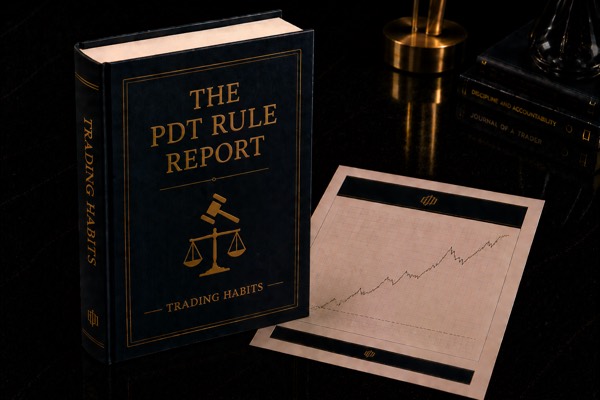
A Trading Habits Report
The PDT Rule Report
What the $25,000 day-trading rule required, why FINRA replaced it after 25 years, and what the new margin standard means for a small account now.
- Length 20 pages, with 9 original charts and a 20,000-account simulation
- Author TradingHabits.com
- Format PDF, delivered as an instant download right after checkout
- Covers The old rule's mechanics, the June 2026 FINRA rule change, what didn't change, and the research on small-account day trading
No stock picks, no tickers, no broker or prop firm recommendations. This report doesn't name a single ticker anywhere. Only the rule, the history, and the math.
What's Inside
20 Things This Report Actually Says
- 01The exact mechanics of the old rule: the four-trade threshold, the 6 percent test, and what happened the moment an account got flagged, so you know precisely what used to trip the wire, not a vague recollection of "the $25k rule."Page 4
- 02Why the rule landed in February 2001 specifically, and what regulators were reacting to, so the rule stops feeling arbitrary and starts making sense as a response to a real event.Page 5
- 03The 1999 NASAA study that sat behind the $25,000 number: how many day traders lost money, and how few beat minimum wage, so you see the actual evidence a regulator built a rule on.Page 6
- 04The full FINRA timeline from the October 2024 review notice through the June 4, 2026 effective date, with the SEC release number attached, so you can verify every claim in this report yourself instead of taking it on faith.Page 7
- 05What replaced the day-trade counter, and why an account can now trade fifteen times in a day without tripping anything the old rule would have flagged, so you know exactly what governs your account right now, not what used to.Page 8
- 06What the 90-day restriction is tied to now, since it didn't disappear, it changed triggers, so you don't get blindsided by a restriction you assumed the rule change removed.Page 8
- 07FINRA's own stated reasoning for scrapping a 25-year-old rule, straight from the regulatory notices, so you're working from the regulator's actual logic, not a forum's guess at it.Page 9
- 08What didn't change: the good faith violation rule, and why a cash account can still get restricted with the PDT rule completely gone, so you don't assume every account restriction vanished along with the day-trade counter.Page 10
- 09The mechanical reason the old rule never applied to funded prop-trading accounts, and how that shaped an entire industry, so you understand why that industry exists in the shape it does.Page 11
- 10What a 2019 study of 1,551 Brazilian day traders found after tracking them for more than 300 days each, so you're weighing your own odds against a real tracked sample, not a survivorship-biased highlight reel.Page 12
- 11The exact share of that group who made more than minimum wage from day trading. It's not eleven percent, so you know the real number instead of a rounder figure that sounds more encouraging.Page 12
- 12The SEC's own cost illustration: what 29 trades a day costs over a year, in the regulator's own numbers, so the cost of frequent trading is a figure you've seen, not a feeling you've had.Page 13
- 13A hypothetical account walkthrough comparing a trader's weekly trade count under the old rule against the same trader under the new one, so the abstract rule change becomes a concrete, side-by-side comparison.Page 14
- 14How this report built its own simulation from scratch: a small negative edge, applied across two different trade frequencies, so you can judge the method behind the numbers, not just the numbers themselves.Page 15
- 15The exact median ending balance for 20,000 simulated accounts at 60 trades a year versus 300, so the headline numbers above come with the full context behind them.Page 15
- 16The full frequency curve, run across every trade count from 20 a year to 500, charted in one place, so you see where the cost of extra trades accelerates instead of a single two-point comparison.Page 16
- 17Why a more precise monitoring system isn't the same thing as a safer one, and what that means for leverage specifically, so you know the risk didn't disappear along with the old counter.Page 17
- 18A six-question framework built to be asked before a trade goes in under the new rules, not after a restriction shows up, so you get a repeatable check instead of finding out the hard way.Page 18
- 19Every source named directly: the FINRA notices, the SEC release, the academic paper, and the exact figure each one backs up, so nothing in this report asks you to just trust it.Page 19
- 20Why this entire report was written without naming a single ticker, and why that wasn't a hard rule to follow, so you know exactly what kind of report you're getting before you're three pages in.Page 2
HABITS
★
Certificate of Guarantee
60-Day, No-Questions-Asked
If The PDT Rule Report doesn't earn its place on your desk, email us any time within 60 days of purchase for a full refund. No form to fill out. No reason required.
Instant Download
$9One-time payment. No subscription.
Order Now20-PAGE PDF · DELIVERED IMMEDIATELY AFTER CHECKOUT · 60-DAY GUARANTEE
Behind The Report
Twenty-Five Years, One Notice, Gone

The old gate had one fixed number. What replaced it doesn't work that way anymore.
Built For A Different Market
NASD adopted the pattern day trader rule effective February 27, 2001, in the wreckage of the dot-com crash, aimed at a wave of newly online retail traders who had no risk cushion behind them. A NASAA study the same era found at least 70 percent of day traders studied lost money.
For twenty-five years, that $25,000 line barely moved, even as commissions went to zero and order execution got faster than the rule's authors could have pictured in 2001.
Then FINRA Opened The File
A formal review opened in October 2024. The SEC granted accelerated approval in April 2026. The new intraday margin standard became effective June 4, 2026, with FINRA's own notices describing the old fixed-count, fixed-dollar approach as out of step with what modern risk systems can watch in live.
The day-trade counter is gone. What replaced it, what didn't change alongside it, and what the research says regardless of which rule is on the books, all of it is in the report.
A Rule That Outlasted The Trading Floor It Was Written For
A simplified rendering of the FINRA rulemaking timeline, matching the sourced chart on page 7 of the report. Background only. The report itself covers the mechanics, the research, and the simulation.
Try It: Step Through The Twenty-Five Years
Same four points as the timeline above, with a running years-since-2001 counter computed live off each date. The rule sat unchanged for roughly 23 years before FINRA even opened a review, then took less than two more to fully replace it.
Background only. Nothing on this page or in this report is a recommendation to buy, sell, or hold any security, or to use any specific broker or trading program.
Common Questions
How long did the pattern day trader rule actually last?
Twenty-five years almost to the point, from taking effect in February 2001 to being fully replaced on June 4, 2026.
Why did NASD create the rule in the first place?
In the aftermath of the dot-com crash, aimed at a wave of newly online retail traders with no risk cushion behind them. A NASAA study from around that era found at least 70 percent of the day traders studied lost money.
How fast did the replacement move once FINRA opened the file?
Faster than the original rule's twenty-five-year run suggests. FINRA opened a formal review in October 2024, the SEC granted accelerated approval in April 2026, and the new standard was in effect by June, under two years start to finish.
Does the underlying research about day trading risk change now that the rule is gone?
No. The rule and the research it was built to guard against are two separate things. The report covers both, and only one of them expired in 2026.