Most Challenge Accounts Don't Fail On A Bad Trade. They Fail On A Rule That Got Read Once, Skimmed, And Forgotten.
FTMO, Apex, Topstep, and dozens of firms behind them sell the same basic setup.
Pass an evaluation, trade the firm's capital, keep a cut of what it makes.
That part isn't a scam.
The fine print under it is where accounts die.
A max drawdown and a daily drawdown are not the same rule.
A trailing drawdown and a static one are not the same rule either, and that difference decides whether a green week can still end a challenge overnight.
You'll get the three firms most traders use compared directly, the exact math behind passing a $50K challenge, what a firm's consistency rule is built to catch, and the specific habits that pass an evaluation and then blow up the funded account thirty days later.
Ten modules.
The rules, the math, and the discipline it takes to get funded and stay funded, not pass once and learn the hard part twice.
Introducing The Prop Firm Trading System.
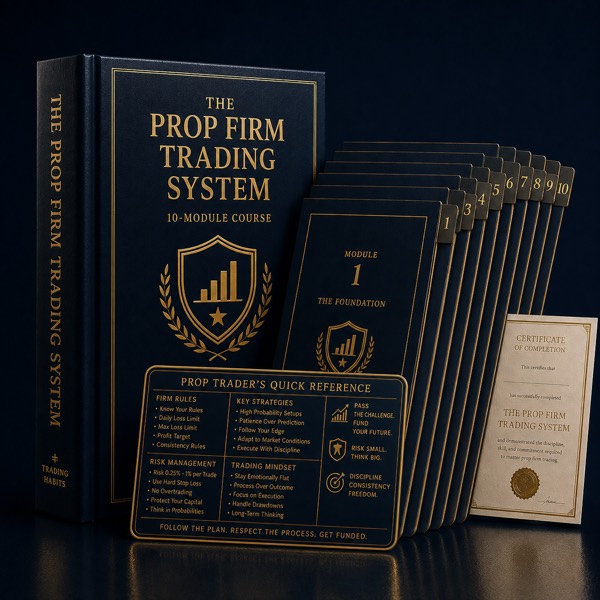
A Trading Habits Course
The Prop Firm Trading System
FTMO, Apex, and Topstep: the drawdown rules, the consistency traps, and the challenge math that decides who gets funded and who gets fooled.
- Length 10 modules, built for genuine depth, not padding
- Format A private, self-paced course page with working drawdown, challenge-pass, and payout-split calculators built into the lessons, not links out to them
- Access Instant, right after checkout, yours to re-read for good
- Covers How the challenge-fee model works, FTMO/Apex/Topstep evaluation structures, max vs. daily vs. trailing drawdown, the consistency rule, passing a $50K challenge, funded-account scaling and payouts, strategies built for tight daily-loss limits, the psychology of the funded stage, and a due-diligence checklist before wiring an evaluation fee anywhere
- Author TradingHabits.com
Built for one job: understanding exactly what a prop firm's rulebook is protecting against before an evaluation fee gets paid, not after a funded account gets pulled.



Try It First
One Rules-Under-Pressure Read Before You Buy
This is one drill from the 15-scenario Setup Practice Lab in Module 8, not the whole lab. Watch the candle build the way it does mid-challenge, call Buy or Sell before the print finishes with the day's rules still in play, then see what happened. It's a real, scored drill running right here, not a description of the module.
What's Inside
The 10 Modules
- 01What a prop firm actually is: the challenge-fee model, where the money flows, and the 2012 launch that started the industry, so you know exactly what you're paying for before the fee leaves your account.Module 1
- 02The Big Three compared: FTMO, Apex, and Topstep, evaluation structure, drawdown rules, and profit split, side by side, so you're choosing a firm on its actual terms instead of a review site's summary.Module 2
- 03Max drawdown, daily drawdown, and the trailing trap, with a working drawdown-floor calculator, so you know your exact floor before you're anywhere near it.Module 3
- 04The consistency rule and the other silent disqualifiers that end a challenge without breaching the drawdown line, the failures that feel unfair only because nobody explained the rule first.Module 4
- 05How to pass a $50K challenge: the profit-target math, worked and calculable, turning a vague goal into a number to hit per day.Module 5
- 06Funded-account management: scaling plans, payout cadence, and a working payout-split calculator, so getting funded is the start of a plan, not the end of one.Module 6
- 07Whose rule is it: a scenario-based knowledge check across all three firms' actual mechanics, the test that catches a gap in understanding before a live account does.Module 7
- 08Prop-firm strategies that fit a tight daily-loss limit, and why some retail strategies don't translate, so you're not importing a habit that gets an evaluation pulled.Module 8
- 09The psychology of the challenge: why traders pass in simulation and unravel once the account is funded, and what actually changes between the two.Module 9
- 10Red flags, due diligence, and a 6-week plan from first challenge to first payout, so the whole process has a map instead of a guess.Module 10
HABITS
★
Certificate of Guarantee
60-Day, No-Questions-Asked
If The Prop Firm Trading System doesn't earn its place in your process, email us any time within 60 days of purchase for a full refund. No form to fill out. No reason required.
Backed personally by Jason Parker, founder of Trading Habits. He built this himself, covered by the same guarantee above.
Instant Access
$299One-time payment. No subscription.
Get Instant Access10-MODULE DIGITAL COURSE · DELIVERED IMMEDIATELY AFTER CHECKOUT · 60-DAY GUARANTEE
Behind The Course
Where the Funded-Account Model Actually Started
July 2012
Michael Patak, a former floor trader at the Chicago Board of Trade, launched Topstep in Chicago. The business model was explicit from day one: build an evaluation modeled directly on the NFL Scouting Combine, an audition on simulated capital before a trader ever sees the firm's own money.
2015 to 2021
FTMO launched in Prague in 2015, rebranding internationally under that name by 2017. Apex Trader Funding followed in 2021 out of Austin, Texas, built specifically around futures. The challenge-fee model Topstep pioneered had, within a decade, spread into dozens of firms competing on account size, drawdown terms, and profit split.
One Firm's Model, a Decade of Imitators
Three dated launches, one model: pay to prove it, trade the firm's capital, split what it makes.
Try It: The Trailing Drawdown Math From Module 3
Same mechanic Module 3 walks through by name: a trailing floor rises with every new equity high and never drops back down, which means the cushion below price can shrink even on a winning week.
Background only. The course itself works the drawdown, consistency-rule, and challenge-pass mechanics an actual evaluation runs on, firm by firm.
Common Questions
Who started the funded-account evaluation model?
Michael Patak, a former floor trader at the Chicago Board of Trade, launched Topstep in Chicago in July 2012. The model was explicit from day one: an evaluation built on simulated capital, modeled directly on the NFL Scouting Combine.
How fast did the model spread to other firms?
FTMO launched in Prague in 2015 and rebranded internationally by 2017. Apex Trader Funding followed in 2021 out of Austin, Texas, built specifically around futures. Within a decade of Topstep's launch, dozens of firms were competing on account size, drawdown terms, and profit split.
What does a "trailing drawdown" do as an account gains value?
It rises with every new equity high and never drops back down, which means the cushion below price can shrink even during a winning week. Module 3 walks through that exact mechanic by name.