A 40-Trade Day With A $5 Hidden Leak Per Trade Is $200 Gone Before Any Setup Even Worked
There's a number every scalper needs before the first trade of the day, and it has nothing to do with the ticker on the screen: the exact dollar cost of getting in and back out, one time.
Commission, spread, and slippage add up to one number, the cost of a single round trip, and most traders never write it down.
This course starts with that number and doesn't let go of it.
You'll get the breakeven math behind every round trip worked in real numbers, the liquidity checklist that decides whether an instrument can be scalped at all, five setup archetypes to study and backtest yourself, and the position sizing and stop placement built for high trade frequency.
You'll walk out with the full session routine from premarket prep to the post-close journal entry, the five specific failure patterns that end scalping accounts, and an 8-week structured path from simulator to live size with exact gates between each stage.
Introducing The Scalping System — a 10-module Trading Habits course built entirely around the arithmetic and discipline that decide whether a scalping account survives its own trade count. No promise that any of this makes you money, because that promise would be a lie and you'd know it.
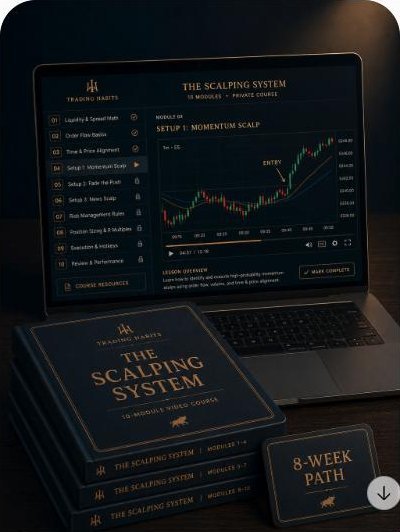
A Trading Habits Course
Everything that has to be true about the math, the instrument, and the routine before scalping is survivable.
- Length 10 modules, built for genuine depth, not padding
- Format A private, self-paced course page. No app, no login system, just your own link
- Access Instant, right after checkout, yours to re-read for good
- Covers Liquidity and spread math, five setups to study and backtest yourself, high-frequency risk sizing, execution and cost control, and an 8-week path from simulator to live size
- Author TradingHabits.com
Built for one job: the arithmetic and the discipline that decide whether a scalping account survives its own trade count.



Try It First
Call It At Scalp Speed
This is one real drill pulled from the 15-drill Setup Practice Lab in Module 5, not the whole lab. The candle builds fast, the way a real scalp forms. Call buy or sell before the next one prints and find out if you kept up. Try it before you buy.
What's Inside
The 10 Modules
- 01What scalping actually is, who it fits, and the honest signs it doesn't fit you yet, so you stop guessing and start trading the style your temperament can actually sustain.Module 1
- 02The breakeven math behind every round trip, worked in genuine numbers until it can't be unseen, so you know your true cost per trade before it quietly eats a winning day.Module 2
- 03The liquidity checklist that decides whether an instrument can be scalped at all, so you stop fighting a chart that was never scalpable to begin with.Module 3
- 04Reading the tape for context instead of certainty, and exactly where that line sits, so you react to what the order flow is actually showing instead of what you want it to show.Module 4
- 05Five setup archetypes to study and backtest yourself, each with its own failure mode spelled out, so you build genuine conviction in a setup before you risk real size on it.Module 5
- 06Position sizing, stop placement, and the daily loss line built for high trade frequency, so one bad stretch can't turn into the day that wipes out the month.Module 6
- 07The full session routine, from premarket prep to the post-close journal entry, so showing up prepared becomes automatic instead of something you have to talk yourself into.Module 7
- 08Order types, hotkeys, and the genuine cost comparison between commission structures, so execution speed stops being the reason a good call turns into a bad fill.Module 8
- 09The five specific failure patterns that end scalping accounts, and how each one starts small, so you can recognize your own account sliding into one while there's still time to stop it.Module 9
- 10An 8-week structured path from simulator to live size, with the exact gates between each stage, so scaling up is a decision you make on evidence, not a leap you make on hope.Module 10
+ Setup Practice Lab in Module 5: 15 interactive candlestick drills. Watch a chart build, call Buy or Sell before the next candle prints, then see what actually happened, at scalping speed, where reading a setup live is a different skill than reading about one.
+ A printable, one-page Quick-Reference Cheat Sheet: every formula, checklist, and rule from all 10 modules, condensed for the desk next to your monitor.
HABITS
★
Certificate of Guarantee
60-Day, No-Questions-Asked
If The Scalping System doesn't earn its place in your process, email us any time within 60 days of purchase for a full refund. No form to fill out. No reason required.

Backed personally by Jason Parker, founder of Trading Habits. He built this himself, covered by the same guarantee above.
Instant Access
$399One-time payment. No subscription.
Get Instant Access10-MODULE DIGITAL COURSE · DELIVERED IMMEDIATELY AFTER CHECKOUT · 60-DAY GUARANTEE
Behind The Course
Two Rule Changes That Built Modern Scalping
Decimalization
Through the 1990s, U.S. stocks traded in fractions, mostly eighths and sixteenths of a dollar, which meant the smallest possible spread on most names was 12.5 cents. The NYSE completed its move to decimal pricing on January 29, 2001, and Nasdaq finished its own conversion on April 9, 2001.
Spreads compressed almost overnight. That single change is a large part of why modern scalping, built around pennies instead of eighths, became mathematically possible at all.
The Pattern Day Trader Rule (Retired 2026)
After heavy retail losses during the 2000 to 2001 dot-com crash, NASD (now FINRA) amended its margin rule for day traders. The change, part of Rule 4210, became effective September 28, 2001, and for the next twenty-five years it capped a margin account under $25,000 at three day trades in a rolling five-business-day window.
FINRA retired the rule on June 4, 2026. The $25,000 threshold and the "pattern day trader" label are both gone, replaced by an intraday margin standard that watches a broker's actual exposure through the day instead of counting trades against a fixed number. Module 6 covers what that changed and what it didn't, including the settled-funds timing a cash account still runs on.
Why Pennies Instead Of Eighths Changed The Math
Illustrative, not a live quote: the smallest typical spread on a fractionally priced stock was one eighth of a dollar, 12.5 cents. After decimalization completed in 2001, spreads compressed toward pennies. That's most of why scalping in cents instead of eighths became mathematically possible.
Try It: What The Old Spread Would Have Cost You
Same two spread values as the chart above, 12.5 cents pre-2001 and roughly 1 cent post-2001, run against your own share size and trade count. Slide back to the pre-2001 side and watch the daily cost of just crossing the spread jump on size and frequency that would look completely normal today.
Background only. The course itself works the liquidity, spread, and position-sizing math a scalping account runs on.
Common Questions
Why did spreads shrink so much after 2001?
Decimalization. Through the 1990s, U.S. stocks traded in fractions, mostly eighths, so the smallest possible spread on most names was 12.5 cents. NYSE finished converting to decimal pricing on January 29, 2001, Nasdaq on April 9, 2001, and spreads compressed toward pennies almost immediately after.
What actually replaced the pattern day trader rule?
An intraday margin standard that watches a broker's genuine exposure through the day, instead of counting trades against a fixed number. FINRA retired the old $25,000 threshold and the three-trades-in-five-days count on June 4, 2026, after twenty-five years on the books.
Does a cash account still run on the old rules?
A cash account was never governed by the pattern day trader rule to begin with. That only ever applied to margin accounts. But a cash account does run on its own settled-funds timing, which Module 6 covers separately from the margin-rule change.
Would the old 12.5-cent spread even matter at today's trade sizes?
Run the live calculator above at your own share size and trade count with the slider set to "Pre-2001" and find out. At sizes that look completely normal today, the old spread alone would have been an expensive daily cost just to cross.