The One Number That Decides If A Small Cap Moves 8% Or 80%
There's a number that decides whether an eight-million-share float stock moves eight percent or eighty, and it has nothing to do with the headline that supposedly caused it.
It's called float rotation, how many times the tradable float changed hands today, measured against a normal session.
Most traders sizing into these names couldn't tell you what it is for the stock they're about to buy.
A stock trading four times its own float in one day isn't reacting to news anymore.
It's reacting to itself.
Small caps don't move like anything else worth studying first.
The float is small enough that a handful of large orders can swing the price whole percentage points.
The spread can go from a penny to thirty cents in the time it takes to read this sentence.
A trading halt can freeze an open position for five minutes with zero way out.
This course is built around that difference, not a large-cap habit dragged over and hoped to still apply.
You'll get ten modules on the float and share-structure math, the genuine catalysts behind these moves, how halts and circuit breakers work, and the risk sizing that has to shrink as the expected range grows, plus the bonus modules, case studies, and calculators that turn each rule into something you can run against a real ticker.
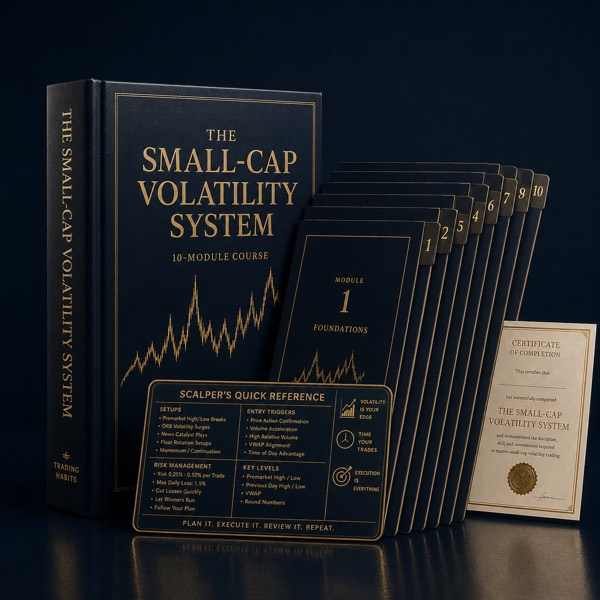
Introducing The Small-Cap Volatility System.
A Trading Habits Course
The Small-Cap Volatility System
The float, catalyst, halt, and risk-sizing mechanics behind the market's wildest names, worked out in full.
- Length 10 modules, built for genuine depth, not padding
- Format A private, self-paced course page. No app, no login system, just your own link
- Access Instant, right after checkout, yours to re-read for good
- Covers Float and dilution math, genuine catalysts versus promotion, halts and LULD bands, liquidity risk in thin names, short-selling risk, and a full watchlist and scanner build
- Bonus 2 bonus modules, 2 full case studies, and interactive tools including a position-size and max-loss calculator, a halt and dilution risk score, a days-to-cover and borrow-cost calculator, a glossary, and a trade journal
- Author TradingHabits.com
Built for one job: understanding why these stocks move the way they do before risking a dollar on the assumption that they'll keep doing it.



Try It First
Call The Halt Reopen Before It Moves
This is one real drill pulled from the 15-drill Setup Practice Lab in Module 6, not the whole lab. A low-float name can turn on one print. Watch the candle build below and call buy or sell before the next one prints, then see what happened. Try it before you buy.
What's Inside
The 10 Modules
- 01What actually makes a small cap "insanely volatile," in float and ownership terms, not vibes.Module 1
- 02The float and share-structure math, including how dilution can cap a rally from underneath.Module 2
- 03The genuine catalysts that move these names, and the red flags that separate news from promotion.Module 3
- 04How trading halts, LULD price bands, and circuit breakers work, mechanically.Module 4
- 05Liquidity risk and spread blowouts in thin names, and the sizing rule that fixes it.Module 5
- 06Four volatility setup archetypes to study and backtest yourself, each with its genuine failure mode.Module 6
- 07Risk management built for names that can move 30% inside an hour.Module 7
- 08Short selling small caps, including borrow fees, forced buy-ins, and the risk this module refuses to soften.Module 8
- 09Reverse splits, dilution filings, and the structural traps hiding in plain sight on an 8-K.Module 9
- 10Building a genuine watchlist, scanner criteria, and a survival-first session routine.Module 10
+ Setup Practice Lab in Module 6: 15 interactive candlestick drills. Watch a chart build, call Buy or Sell before the next candle prints, then see what actually happened. A low-float name can turn on one print, and no amount of reading about it substitutes for reacting to it live.
+ 2 bonus modules and 2 full case studies, plus a position-size and max-loss calculator, a halt and dilution risk score, and a days-to-cover and borrow-cost calculator, so every formula gets run against a real number before you run it against your own account.
+ A printable, one-page Quick-Reference Cheat Sheet: every formula, checklist, and rule from all 10 modules, condensed for the desk next to your monitor.
Finish this and a halt, a gap, or a 40% morning rip stops being a reason to freeze. You'll know within seconds whether the float and the catalyst behind it actually support the move, or whether you're watching someone else's exit liquidity.
HABITS
★
Certificate of Guarantee
60-Day, No-Questions-Asked
If The Small-Cap Volatility System doesn't earn its place in your process, email us any time within 60 days of purchase for a full refund. No form to fill out. No reason required.

Backed personally by Jason Parker, founder of Trading Habits. He built this himself, covered by the same guarantee above.
Instant Access
$399One-time payment. No subscription.
Get Instant Access10-MODULE DIGITAL COURSE · DELIVERED IMMEDIATELY AFTER CHECKOUT · 60-DAY GUARANTEE
Behind The Course
Two Rules Built for Exactly This Volatility
Limit Up-Limit Down
The SEC approved the Limit Up-Limit Down plan on May 31, 2012, replacing an older single-stock circuit breaker system that regulators had put in place after the May 2010 Flash Crash exposed how fast a thin, fast-moving stock could disconnect from any reasonable price. Phase I of LULD took effect April 8, 2013, and full Phase II coverage followed that August.
LULD bands exist precisely because small, thin names are the instruments most likely to move fast enough to need one. Module 4 covers exactly how those bands and the resulting trading pauses work.
Regulation SHO
The SEC adopted Regulation SHO in 2004, and its locate requirement, the rule that a broker must confirm shares can be borrowed before accepting a short sale, was in force by January 2005. It exists because short selling without a genuine locate had let failures to deliver pile up, especially in thinly traded names.
Module 8 covers what a locate requirement, a borrow fee, and a forced buy-in mean for a small-cap short position in practice.
What A Limit Up-Limit Down Pause Looks Like
Illustrative price path, not a live quote: LULD bands sit above and below a rolling reference price. A stock that reaches the band gets a short trading pause instead of an unchecked run, then either resumes inside the band or triggers a longer halt if it can't.
Try It: Find Your Own Limit Up And Limit Down Prices
Genuine SEC-approved percentages, not illustrative: Tier 1 NMS stocks over $3.00 get a 5% band, stocks between $0.75 and $3.00 get 20%, and both double in the last 25 minutes of the session. Type in a reference price and toggle the session to see where the pause would actually trigger. This simplifies the below-$0.75 tier, which uses the lesser of a percentage or a fixed dollar amount instead of a flat percentage.
Background only. The course itself works the float, liquidity, and position-sizing math these names actually run on.
Common Questions
Why do small caps have special trading halts?
The SEC approved the Limit Up-Limit Down plan on May 31, 2012, replacing an older circuit breaker system put in place after the May 2010 Flash Crash exposed how fast a thin, fast-moving stock could disconnect from a reasonable price. Phase I took effect April 8, 2013, with full coverage by that August.
What is the "locate requirement" for shorting a small cap?
A rule under Regulation SHO, adopted by the SEC in 2004 and in force by January 2005, requiring a broker to confirm shares can actually be borrowed before accepting a short sale. It exists because short selling without a genuine locate let failures to deliver pile up, especially in thinly traded names.
How much do LULD bands actually widen near the close?
They double in the last 25 minutes of the session, on top of the standard 5% band for stocks over $3.00 or the 20% band for stocks between $0.75 and $3.00, both genuine SEC-approved percentages, not illustrative ones.